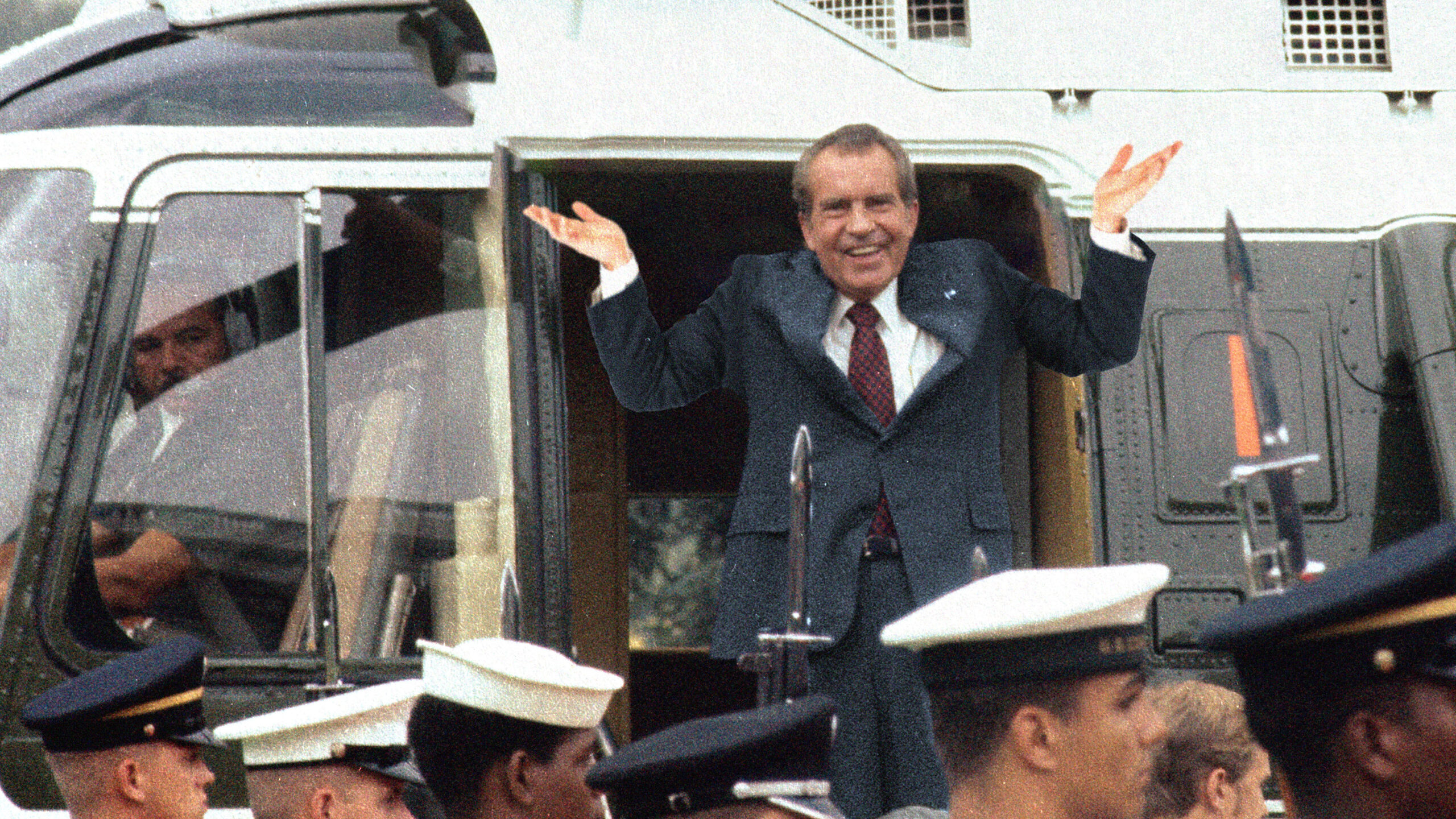
I Know the Dangers JD Vance Just Exposed About This MAGA Moment
For the record, I agree with Vice President Vance: If the right-wing media empire that exists today had been in place in the seventies, President Nixon would have survived Watergate. What the president and his cronies are now so flagrantly doing to corrupt our democratic institutions is far worse than what Nixon did, and it wasn’t pattycakes back then.
Read more Usha Humiliated as She Turns Up to Trump’s Empty Fair
How can Vance chuckle over how easy it is to get away with what would have been impeachable two generations ago? What is the administration he’s serving doing that dwarfs what Nixon did? Lies, cover-ups, and hush-money deals were hallmarks of the seventies’ corrupt power players. Judging by Vance’s smugness, he knows a lot more than he’s telling us.
I wasn’t yet in Washington, but you didn’t need to live here to be shocked at Nixon’s coarseness, his bigotry, how he weaponized the CIA and turned the IRS on his political enemies. Aside from all that, though, he wasn’t crazy—and he did some big, bold, and lasting things, including creating the EPA (Environmental Protection Agency) and PBS (Public Broadcasting System), and signing Title 1X that broke down barriers for women in sports.
And though he yearned to be a president with the Trumpian heft to believe, if not assert, that if he said something, it was true, Nixon did feel a sense of shame over being driven from office. He spent the rest of his life trying to recast his legacy and establish himself as someone whose foreign policy chops were worth paying attention to.
So, what was Vance thinking? Speaking at the Nixon Library, he likened himself to the former disgraced president (who too was a vice president…) as victims of a “deep state” hellbent on destroying any administration that takes the country in a different direction. Of course, it’s comical to cast Nixon as a victim of the established order since he epitomized it—a former senator and former vice president in the Eisenhower administration.
“Vance is talking to the American people, most of whom hadn’t been born (during) Watergate,” says Bill Galston, a senior fellow in the Governance Studies program at Brookings. “He’s painting on a nearly blank canvas.” If people don’t experience history for themselves, they have to be taught, and that’s what Vance is doing—rather, he’s rewriting history for people who only know Watergate as a footnote.
But Watergate was the biggest corruption scandal centered at the White House that the country had ever seen; Vance is elevating Trump (and himself too) when he argues Nixon was unjustly singled out. Never mind that 80 people went to jail for Watergate-related crimes, and it was Republican leaders, including the GOP’s former standard-bearer, Barry Goldwater, who went to Nixon in the White House and told him the jig was up. They were ready to impeach.
The break-in at the Democratic National Committee headquarters at the Watergate hotel had received little media attention until two young reporters at The Washington Post sniffed out a CIA connection and began to tell the improbable story of a cover-up that reached the Oval Office. Nixon’s administration threatened to pull the licenses of Post radio and television stations; Attorney General John Mitchell said Post publisher “Katie Graham’s gonna get her tit caught in a big fat wringer if that’s published,” later prompting her to have a pin of such a scene fashioned, which she wore proudly.
Read more Trump’s Great American State Fair Humiliated by Pickle Company
For a time, the Post stood alone. The story was so unimaginable, and if Nixon had destroyed the tapes, as some counseled him to do, he might have beaten the rap. (The scandal took time to penetrate the country. When Nixon ran for re-election in 1972, he won in a landslide.) But the paper didn’t buckle even as the White House lowered the boom, denying reporters access and denouncing Post stories. Woodward and Bernstein found their “Deep Throat,” Mark Felt, an FBI official who’d been passed over for the top job and was ready to talk.
Indeed, his resignation wouldn’t happen today because in Vance’s recasting, that the “deep state” that’s out to get Trump is the same force that brought down Nixon—with no more justification. And thsi this time they’re not getting their way, Vance promises.
As we mark the country’s 250th birthday, a milestone that the Founding Fathers would no doubt find remarkable, we have the context of history to rebut what Vance is trying to create as a new authoritarian moment. The Supreme Court is handing down decisions that Nixon could only dream of—immunity from criminal acts if you’re president!—and if there’s a red line that Trump won’t cross, we haven’t seen it yet.
Vance should go back and read Nixon’s tearful farewell statement on August 9, 1974, less than two years after his landslide win: “Always remember others may hate you, but those who hate you don’t win unless you hate them, and then you destroy yourself.”
It was a moment of clarity for a man who spent his life nursing grievances, and an admonition that Vance might consider before he wades too much deeper into the swamp at the front of an administration that dismisses Watergate-level crimes as nothing more than a 12-hour news cycle.
Vance thinks he can get away with such a glib and dangerous comparison because, well, when everything is outrageous, nothing is. Normalizing everything Trump does, touting the chaos and the cruelty as part of governing a vast remarkable nation rather than tallying the cost to human beings.
The Washington Post saved us from Nixon. Today’s media is fast and furious, but too often signifies nothing. The only thing that can save us from Trump and his excesses are the voters.
Read more Why Every Epic Fail at Trump’s ‘Great’ State Fair is a Metaphor











Post Comment