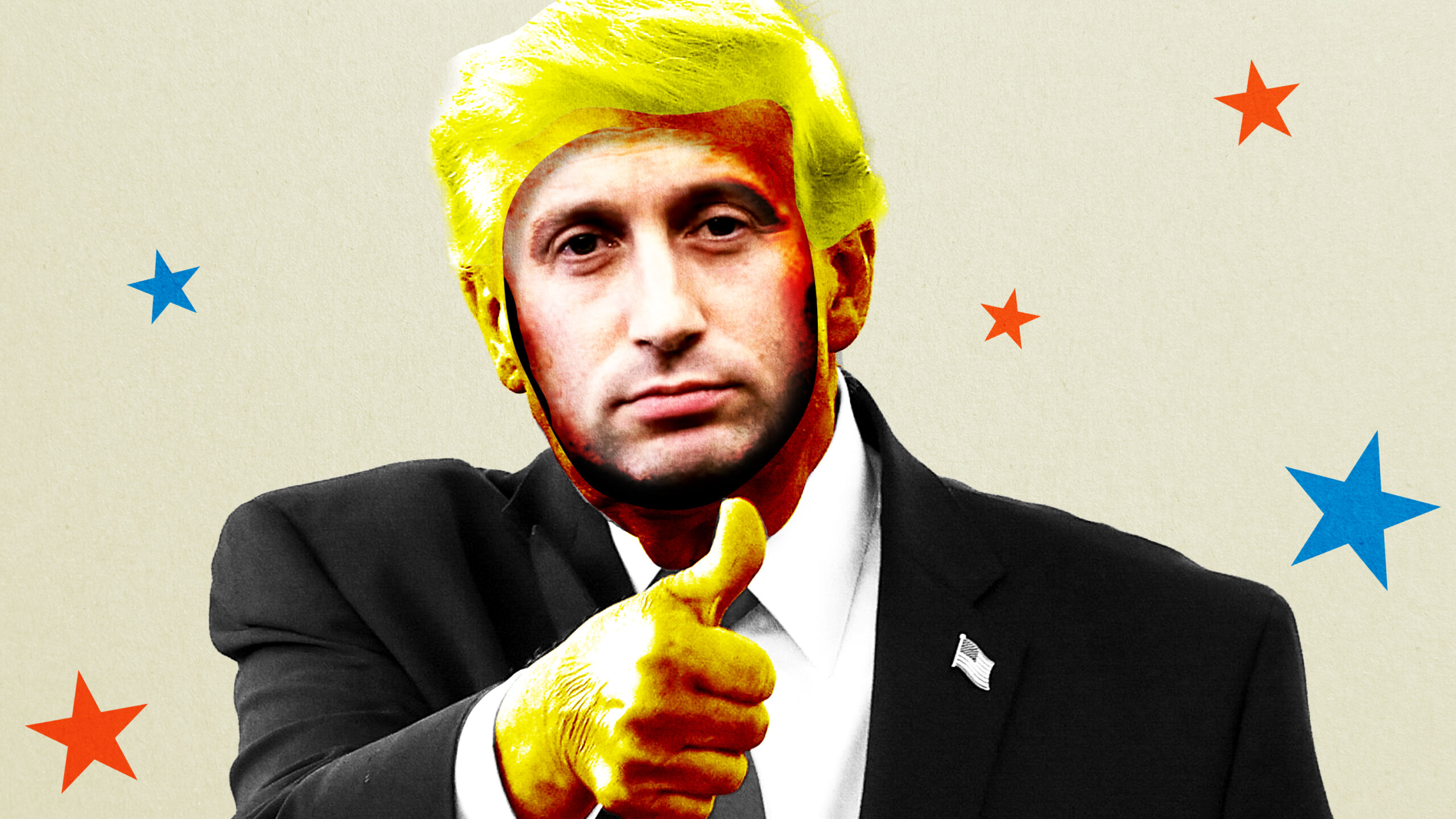
Trump Is Fading Fast. Who’s Really Running the White House Now?
We are watching the president ripen and rot before our very eyes.
If he were a banana, he’d be in the trash right now—or, at best, on his way into a recipe for banana bread.
Read more Disturbing Crisis Erupts Among Sailors in Trump’s War
From swollen ankles and bruised hands, we’ve watched this deterioration progress with each passing day. This week saw a progression of bruises up his arms. He is barely able to stay awake at virtually any public function he attends. His behavior is erratic. His already limited vocabulary is increasingly beyond his recall. He needs to be propped up when he walks any distance at all. According to reports, he emits strange odors.
It’s not pretty.
Given the president’s awesome power and responsibilities, this kind of rapid degradation of health and capacity to govern ought to be a source not just of concern, but of action. Yes, Trump’s handlers are apparently restricting his schedule. But stronger measures are called for. In a mid-size corporation, he would have been given a gold watch and a hearty pat on the back and sent on his way.
In the White House, however, what succession mechanisms there are often are ignored. In the case of Trump, this is true in part because of his ego. He is in denial about the fact that he has gone from being merely unfit to hold the office (as he was on day one) to exploring new extremes of unfitmaxxing. Almost certainly, suggesting it was time to invoke the 25th Amendment would be grounds for firing. Not just because Trump would see it as disloyal but because it would also open the door to the possibility of President JD Vance, an outcome no one wants to see.
But there are other reasons why the White House promotes the myth that flaccid, slumped, shuffling, mentally crumbling Donald Trump is healthy and capable enough to be president. They all tie to the fact that Trump is not the only person who stands to benefit from his being president. His family profits from it. His senior staff has influence and even power they would never otherwise have.
Donald Trump is not just a cash cow for his own corrupt enterprises. He is also the meal ticket for those closest to him.
That is why it is likely that, even as he continues his slow, sad collapse, it will be covered up and lied about, possibly long after he is effectively non compos mentis.
The Weekend at Bernie’s presidency is a real possibility—and we need to prepare for it. (To some extent, it is very likely it is already happening.)
On multiple occasions have presidents become incapacitated or weakened, with their conditions hidden and their responsibilities and prerogatives farmed out to or seized by close associates. Indeed, in my 2009 book The Inside Story of the National Security Council and the Architects of American Power, I spoke with numerous government officials who, in past decades and administrations, have been in the room when these decisions and power plays have been made.
For two and a half months in 1881, between the time James A. Garfield was shot and his death in mid-September, the country was run by an informal committee led by Secretary of State James G. Blaine, and including the president’s wife Lucretia, who controlled Garfield’s sickroom, making decisions while putting out disingenuous statements that “the president is doing well.”
Chester Arthur and Grover Cleveland both concealed very serious illnesses that their administrations denied.
On October 2, 1919, Woodrow Wilson suffered a massive stroke. The president’s physician, a friend, issued statements saying he had “digestive upset” or was suffering from exhaustion, never acknowledging the nature or severity of the illness. For six months, Wilson’s wife, Edith Galt Wilson, controlled all access to the president and screened every paper that came his way. She later wrote of deciding what was important and what was not and even writing notes ostensibly from her husband to his team. This famous case was one of the prime reasons we ended up with the 25th Amendment just under half a century later.
Read more MAGA ‘Zapper’ Reveals Real Reason Behind Trump Sleep Rumors
Franklin Roosevelt suffered a serious case of cardiovascular collapse which impacted his ability to function for over a year before his death in April 1945. Again, a committee stepped in, though Vice President Truman was not informed about the president’s condition.
Dwight Eisenhower, in the middle of his term, had a heart attack, ileitis surgery, and a stroke. While his team actually made the choice to be transparent about his condition and they ran a disciplined process throughout, his chief of staff, Sherman Adams, was widely seen as having an outsized role. In addition, Eisenhower’s critics used the incidents to criticize him for being a part-time president.
During John F. Kennedy’s presidency, his serious health challenges, which included Addison’s Disease, degenerative back disease, colitis, and the many medications he received to manage these conditions, were largely kept a secret— and there were a series of lies told denying he had Addison’s disease.
During Watergate, Richard Nixon took to drinking heavily and became emotionally strained. Both Henry Kissinger and Alexander Haig told me on separate occasions of how they would work around the president when he was drunk, often turning to senior staff to make decisions rather than to wake Nixon or deal with his irrational behavior. (During this time, Kissinger kept Nixon from speaking to British Prime Minister Edward Heath, telling Brent Scowcroft “he’s loaded.”) And during Nixon’s final days, Defense Secretary Jim Schlesinger, with whom I also spoke, instructed the Joint Chiefs that any unusual order—and, specifically, any nuclear order—from the White House should be routed through him and verified before being executed.
Similarly, in the last years of Ronald Reagan’s presidency, when he was suffering early stages of dementia and with his body weakened by the consequences of the 1981 assassination attempt, his team was worried about him and also developed “workarounds.” A staff report found him inattentive, disengaged and “not really in charge.” I spoke with some members of his senior team, including Defense Secretary Frank Carlucci and National Security Advisor Colin Powell, and both said the team agreed not to bother the president after 5 p.m. except under the most extreme circumstances and said that certain decisions were farmed out to senior staff. On some occasions, though, others played a significant role. For example, First Lady Nancy Reagan ended up being a decisive vote on a number of personnel decisions.
It has happened elsewhere too, throughout history. In one notable example, German president Paul von Hindenburg went into serious, senile decline in his last years and a committee made decisions on his behalf. In one instance, while Hindenburg had vowed never to make Adolf Hitler chancellor, this committee nonetheless did. Hiding the decline of leaders and arrogating their powers onto themselves is found particularly often in authoritarian societies, as in the case of Vladimir Lenin (whose gatekeeper was Stalin), Stalin himself, Leonid Brezhnev, and Mao Zedong.
In many of these cases, there are patterns worth noting. Often power flowed to those with proximity to the stricken leader—not necessarily to those who were in any legal line of succession. Arguments about national security are often used to prohibit disclosure of the leader’s condition.s of the leader. Further, sometimes those in effective control make decisions contrary to what the leader would have wanted.
While that last point might seem a pleasing prospect in the case of Trump, whose decisions have often proved disastrous, the others are more concerning. We already know Trump lies about his health. Indeed, we know this administration is anything but transparent. We also know that many around the president would never have the power they currently have in another administration and might be in legal jeopardy.
So, what does that suggest? Is it far-fetched to imagine that, as Trump continues to decline, a small group emerges around him to handle some of his workload, make some of his decisions, claim certain elements of power themselves?
Surely Melania, the AWOL wife, will not claim power as Edith Wilson did. But could Deputy White House Chief of Staff Stephen Miller, or Trump’s sons, or other power-hungry Trump inner circle members decide that even though Trump is no longer up to the job, they could make up the difference and, in so doing, benefit themselves?
Not only is such a scenario worth contemplating given what history teaches us, but what we see happening in and around Trump right now suggests it may already have begun. Trump can’t keep a thought in his head for five minutes straight. He barely understands the key decisions he makes. Who is currently saying, “I’ve got this, boss? Trust me.”
Read more True Jaw-Dropping Cost of Trump’s White House Desecration Exposed
Are you comfortable with the prospect of Shadow President Stephen Miller?
It’s something we all might want to consider sooner rather than later.











Post Comment