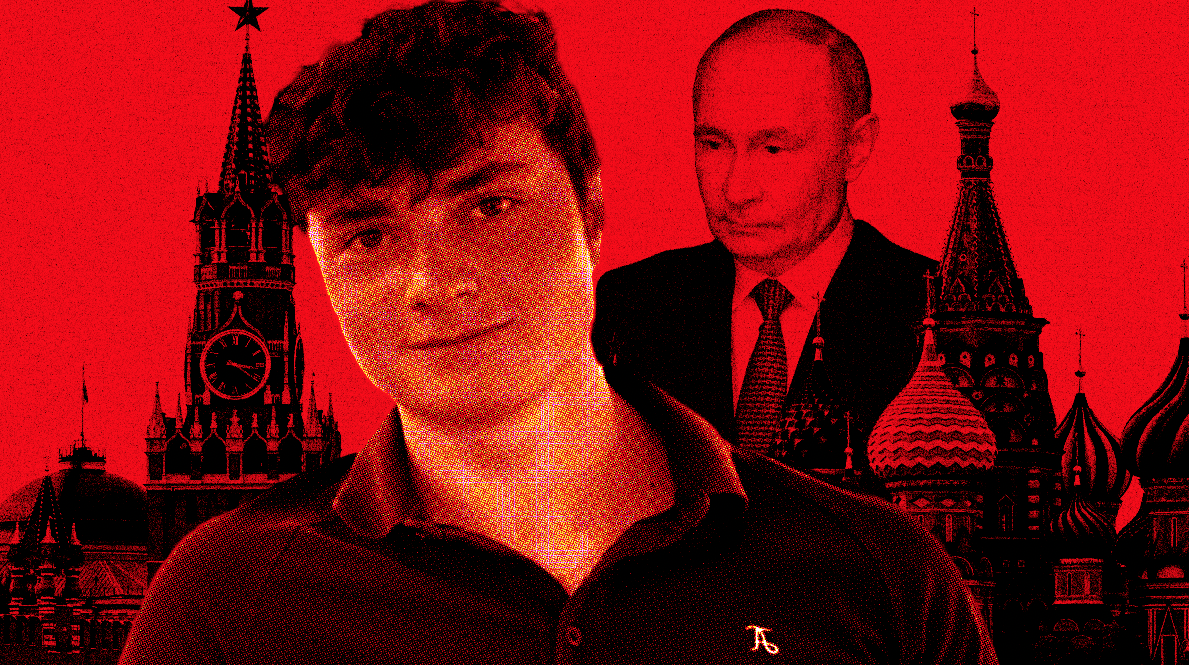
‘I Was in High School Class When I Found Out I Got Sanctioned by Putin at 17’
When speaking to Alexander Browder, it is clear that he is courteous, polite, and perhaps even a bit nervous. That’s to be expected, though, because he’s only just turned 17.
Read more Did a Judge’s Ruling Save the Kennedy Center—Or Condemn It?
He’s like any other high school student in some ways. He chats with his buddies on WhatsApp, and he enjoys video games and sports. Pickleball, he says, is his sport of choice.
However, he’s finding that he has less and less time to do these things. That’s because he’s taking on the Russian tyrant Vladimir Putin.
“It’s clear that my work has touched a nerve,” he says, growing in confidence as he chats about how he was just sanctioned by the Kremlin.
Alex, as his friends know him, was in an economics class at school on Wednesday when he was surfing the web, looking at news about his favorite subject: crypto.
“Wow,” he thought to himself after stumbling upon a Reuters article listing five Brits now banned from entering Russia by Putin’s Kremlin.
He read down the list of names, and then saw his own, in esteemed company. “It came to me as a surprise,” he tells the Daily Beast.
The charge? Writing “a disinformation report for the Henry Jackson Society,” a trans-Atlantic foreign policy and national security think tank, based in Alex’s hometown, London.
His focused on cryptocurrency laundering, a charge he levels against Putin, who counts the teen as his newest foe, but his second in the Browder family. The report was so good that Alex presented key findings and policy recommendations at the House of Commons in a briefing attended by top politicians from both sides of the aisle in the U.K.
But the best compliment to Alex’s work, he says, is that it has angered the “right people.”
Asked if he was alarmed by the fact that Putin, a man regularly accused of vanquishing his political foes, has him in his sights, Alex did not hesitate.
“It will not change my work, and it only motivates me further,” he says, invigorated by the thought of working to “expose all their different schemes.”
His research focuses on the Russian-backed stablecoin, A7A5. The Kremlin uses cryptocurrency to circumvent sanctions imposed by countries around the world, including the U.S. Alex calls A7A5 “one of the most critical threats to the effectiveness” of sanctions on Russia. And without sanctions, Russia’s war machine can keep rolling on, funded by illicit gains.
Read more Trump Goon Lashes Out at Senator’s Son Over Epstein Links
“It’s unprecedented for the Russians to sanction a 17-year-old. It clearly shows what I’m doing is having an effect. I’m greatly proud of that. It gives me hope that what I’m doing is helping people, taking down the bad actors,” he says.
Russia’s entry-ban sanctions list is the most common form of sanction. It often targets foreign politicians, journalists, academics, and activists. Even though Moscow does not publish age records for sanctioned individuals, Alex appears to be among the youngest foreign nationals ever sanctioned by the Russian government.
“I’m not like most 17-year-olds,” he says, almost sheepishly.
He thinks his age works to his advantage because he is a digital native, and then some. “This is an area where being young is actually a huge advantage, as I am able to understand all of the complicated aspects. I think you need people like me, especially young people in this situation, to expose avenues that other people may not understand, especially in technology and in cryptocurrency,” he tells the Daily Beast.
Alex also has a family history in exposing Putin’s corruption.
His Chicago-born father is Bill Browder, one of the most prominent critics of the longtime Russian leader.
He was once one of the largest foreign investors in Russia through his investment fund, Hermitage Capital Management. In the 1990s and early 2000s, Browder was initially supportive of Putin because he believed the Kremlin would crack down on oligarch corruption. But that relationship collapsed as Browder began publicly exposing corruption at major Russian companies.
This, of course, earned him the ire of Putin, who demanded that Donald Trump, during his first term, silence the former investment-fund manager. U.S. Customs and Border Protection agency officials were left scrambling in October 2017 after the Kremlin issued an Interpol alert calling for Browder’s arrest as he tried to enter the U.S.
The former U.S. ambassador to Russia, Michael McFaul, was among those to call on Trump and the State Department to deal with the “outrageous” issue immediately and allow Browder to travel unimpeded.
Browder knew full well how dangerous his work was, and he’d sounded the alarm in the U.S. His lawyer, Sergei Magnitsky, had uncovered what Browder Sr. said was a massive tax-fraud scheme involving Russian officials years earlier. Magnitsky was arrested in 2008 and died in a Moscow prison in 2009 after nearly a year in detention. He was tortured and eventually succumbed to a lack of medical care.
Browder Sr. took the Magnitsky case to Congress, leading to the passage of the Magnitsky Act in 2012. Signed by then-President Barack Obama, the law imposed sanctions on Russian officials linked to corruption and human rights abuses. Putin fiercely opposed the measure, later banning U.S. adoptions of Russian children and pursuing a posthumous prosecution of Magnitsky. U.S. intelligence agencies also assessed that Russia interfered in the 2016 election, in part because of the Kremlin’s hostility toward the law.
“I think it’s passed down through my genetics. I’m very proud of my father, but I’m biased. So, I’m just trying to live up to that same steadfastness and tenacity in taking down these bad actors,” Browder Jr. tells the Daily Beast.
Asked if the Kremlin sanctions had derailed any plans to visit the country, he said: “I’d love to go to Russia when it is a normal democratic country.”
Read more Fox News Host Ambushes MAGA Goon With Angry Trump Voters








Post Comment