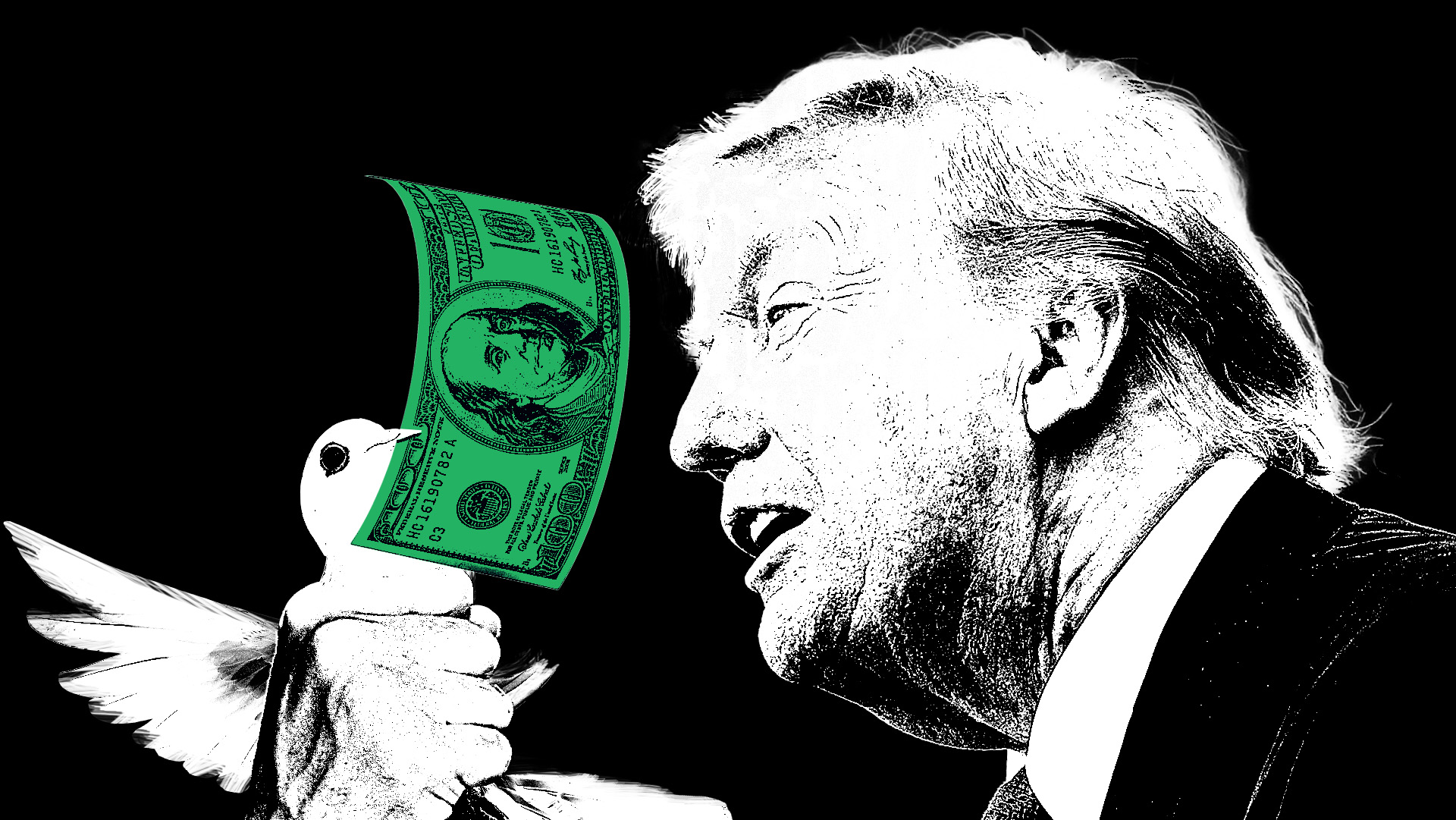
Trump’s ‘Peace President’ BS Blown Up by People He Promised to Save
Donald Trump’s boasts of being the “Peace President” have been blown apart by some of the very people he pledged to save from war.
Read more James Carville Issues Blunt Message to Trump Staffers
Trump’s much-derided memorandum of understanding with Iran makes for the ninth conflict he claims to have ended as president—but when you spend time in one of the places he was supposed to come to the rescue of, it’s clear that those boasts are worthless.
Amma, a teenager who has never been able to visit her homeland in the Western Sahara after her family’s life there was shattered by decades of war, says Trump has reduced her people’s fate to a bargaining chip. She withheld her surname to address the president directly from a refugee camp in Algeria. “We have names, dreams, and mothers dying without medicine after U.S. funding cuts in 2025,” she says. “We are human beings, not a deal. Do not forget that.”
The same could be said for Gaza, eastern Congo, Kashmir, or anywhere else he claims to have “saved maybe hundreds and millions of lives” in his mission to “stop wars” since he retook the White House. But it’s here on the ground that you realize just how little he cares about these disputes beyond their ability to win him the Nobel Peace Prize that he craves.
His most direct words on the Western Sahara conflict this term came in a message to Morocco’s king last summer, when he wrote that Morocco’s proposals for an end to the war were “the only basis for a just and lasting solution.” His ambassador to the U.N., Mike Waltz, told the organization in October that “regional peace is possible this year.”
The disputed territory in northwest Africa has endured bitter conflict since the mid-1970s, when Morocco drove the region’s native Sahrawi people—represented by the Polisario Front—out into the desert in neighboring Algeria.
But, as ever, Trump’s diplomatic dealmaking has arguably led to more tension than calm. Sahrawi leaders are clear-eyed about the president’s relationship with Morocco and fear he could trade away their independence the moment it suits him.
During his first term, Trump ripped up decades of U.S. policy on Western Sahara and recognized Morocco’s claim over “Africa’s Last Colony” in exchange for normalizing ties with Israel under the Abraham Accords—negotiated by his son-in-law, Jared Kushner.
Greasing the gears in his second term has been Massad Boulos, father-in-law of Trump’s youngest daughter, Tiffany.
Boulos’ time as White House adviser on Africa so far has seen Morocco embark on an arms binge. The government in Rabat, the Moroccan capital, has spent hundreds of millions on U.S. defense contractors alongside a $1 billion buy-in for Trump’s controversial Board of Peace initiative, all while turning Western Sahara into what Bloomberg has called an “El Dorado” for American businesses. Meanwhile, drastic cuts to U.S. aid have left the Sahrawis struggling to survive.
Trump’s art of the deal here has been picking a winner before the race began. But the Polisario Front won’t budge, refusing to accept autonomy under Moroccan sovereignty as the basis of talks.
“What’s going on is not a negotiation,” says Mohamed Salem, the front’s senior minister for diplomatic affairs. “Why do they choose autonomy on behalf of the Sahrawis? Can we choose on behalf of the Americans?”
The Sahrawi refugee camps in the Algerian desert are a perfect illustration of the stark difference between what the “Peace President” says in the Oval Office and the real people he pledges to save.
Fatimetu Bucharaya is remarkably cheerful for someone explaining how she avoids blowing herself up. It’s 100F in the sandy expanse of the North African desert as she lounges in the shade of a tent billowing in the wind. She has a cup of sugared tea at her feet, as flies buzz around a bowl of camel’s milk sweating in the corner.
“Some of the mines are very old,” she says of her work with an all-female landmine clearance group. “They’re starting to disintegrate, which makes them more dangerous. They could explode any time.”
“But I’m always under control. I’m not a normal woman—I’m a specialist,” she says. “And I’m proud of the work I do, because it saves lives.”
Bucharaya is the subject of a documentary called Dissonance, one of several films showing at FiSahara, a festival held inside the Sahrawi camp.
The war that drove them here, which Trump has pledged and failed to end, dates to 1975, when colonial Spain withdrew from Western Sahara and Morocco invaded, fighting the Polisario until a U.N.-brokered ceasefire in 1991. A promised independence referendum never came, and fighting resumed in 2020.
For the camp’s elders, that history is memory. Mariam Salama, now 62, recalls fleeing bombs and bullets at the age of 11 with her three brothers, who died when measles tore through the camps the following year. “We came with nothing,” she says. “We slept in the sand, under shelters made from sticks and our clothes.”
Read more Kaitlan Collins Corners Scott Jennings on Slimy Reflecting Pool Defense
“I remember the darkness, and the screaming,” adds Hira Bulahi, Governor of the Auserd refugee camp. “They came only with violence—against the men, but the women and children too.”
Auserd stands today as a monument to resilience. When the Sahrawi first arrived in the ‘70s, it was a bare rocky plateau. Now, it has schools, markets, pizza joints, even fish farms fed by runoff from air-conditioned greenhouses. Almost all of it was built with foreign aid that the Trump administration has now walked away from.
Western Sahara was thrust back into the international spotlight last summer when Boulos announced the U.S. was “committed to fostering lasting peace” in the territory after meeting with the president of Algeria, which has long backed the Polisario.
Three rounds of secret talks followed in D.C. and Madrid between January and February. But Boulos never got the two sides near agreement, and the last round broke up just days before Trump launched his war with Iran. A fourth was penciled in for Washington in May. With Trump’s administration distracted by a new crisis of its own making, it never took place.
Riccardo Fabiani, a senior analyst at the International Crisis Group, says the Trump administration’s cut-throat corporate approach to diplomacy has foundered against the Polisario. “This is the limit of transactional foreign policy,” Fabiani says. “When you meet a principled position, the dialogue inevitably gets stuck.”
Underpinning their position is the fear that autonomy would change little for the Sahrawi still inside Western Sahara. Morocco would keep control of defense, foreign affairs and the territory’s finances, leaving only a regional assembly whose members, according to independent researcher Raouf Farrah, the regime would effectively handpick.
“It’s hard to imagine any improvement in human rights if parliament is basically selected by Morocco,” Farrah explains. “It would be a façade.”
That fear runs through We Are Still Here, a Spanish documentary built around interviews with activists still living in the territory. One of them, Jamila Mojahid, tells the Daily Beast that most of the repression goes unseen.
“These violations don’t make it into most reports because there’s no access to the territory,” she says. “The only documentation is the one we make, under enormous risk to ourselves and our families.”
What has surfaced is harrowing. Stories of torture, arbitrary arrest, and relentless surveillance. Take Sultana Khaya, a leading Sahrawi campaigner held under house arrest from 2020 until her escape to Spain in 2022.
According to Amnesty International, masked agents repeatedly raided the property throughout her confinement. They beat and raped Khaya, sexually assaulting her sister and their 80-year-old mother. No one was ever investigated.
The stalled peace push is not the only pressure the White House has brought. Buhebaini Yahya, president of the Sahrawi Red Crescent, says its aid camps were already barely holding on when the administration’s dismantling of USAID and retreat from U.N. humanitarian funding hit.
By his count, the U.S. had long provided more than half of all aid reaching the Sahrawi, and up to 40 percent of the budgets of the U.N. agencies on which they depend. The U.N. refugee agency’s contribution alone fell from $9.4 million in 2024 to $5.6 million in 2025.
This year, that amount is zero. The cooking gas that once reached some 28,000 families is gone, along with the yeast they need to bake bread and the money for water trucks. Their emergency food stocks are already exhausted.
“I don’t know,” Yahya says when asked what comes next. “I will cry, and then I will continue to advocate.”
This year’s edition of the FiSahara film festival closes with a performance from Armenian-Lebanese violinist Ara Malikian, who fled war in Lebanon as a child. Introducing him, the organizers note that Malikian is one of 120 million displaced worldwide—more than at any other point in recorded history.
It is hard to grapple with the scale of that number. Harder still is how many are now at the mercy of an 80-year-old whose quest to reshape the global order in his own image has seen wars launched, allies abandoned, and entire economies upended with Truth Social posts fired from the hip.
Watching Malikian play, elementary school teacher Hamdi Saleh pauses when asked about the U.S. president, the cuts, and stalled peace talks. He inhales, and gives a patient nod. “There is no autonomy, only independence,” he says. “We have waited 50 years. If we must wait another 50, we will.”
Read more Trump, 80, Spirals as Reflecting Pool Fiasco Takes Another Mortifying Turn








Post Comment