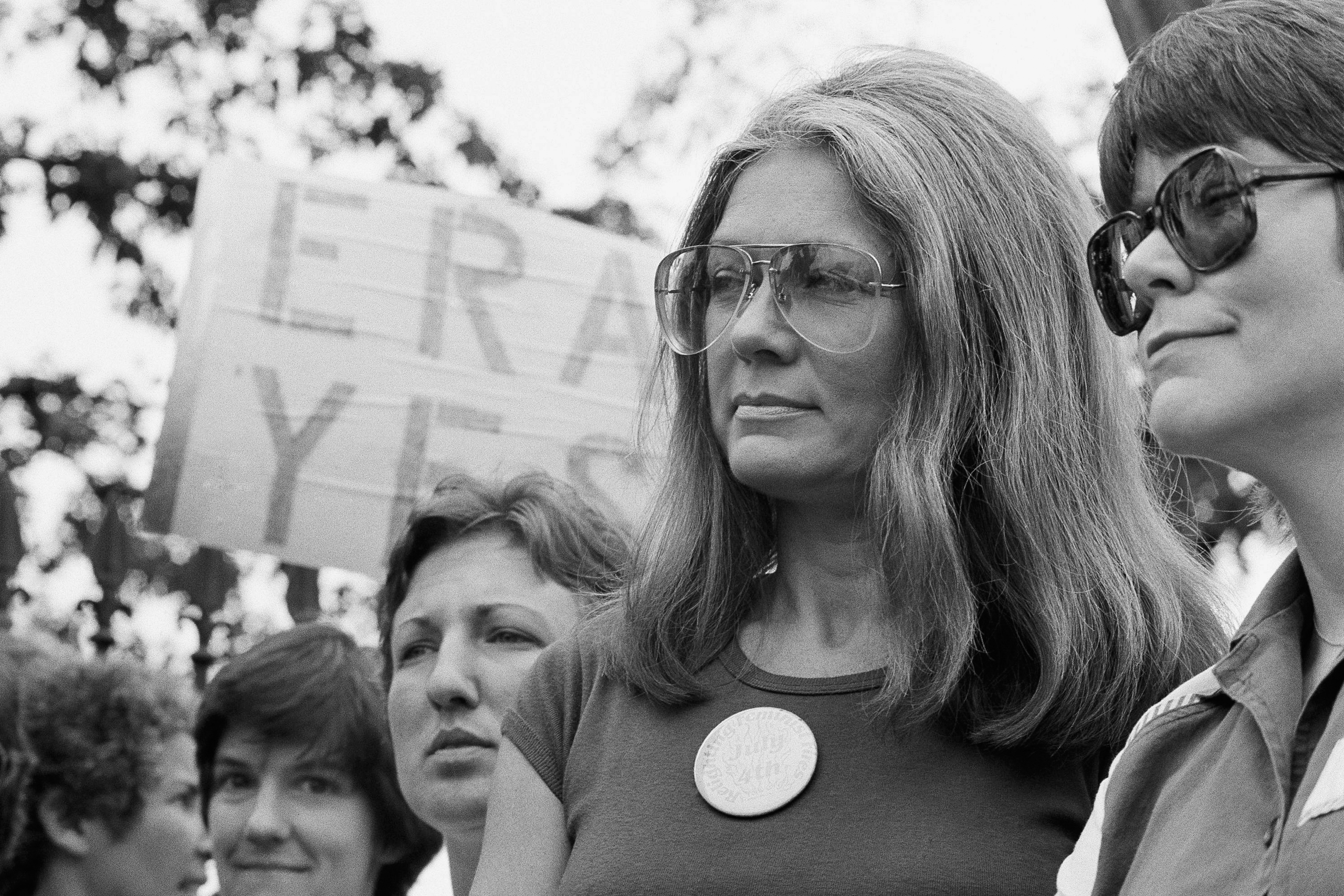
How Gloria Steinem Inspired Generations of Women—Including Me
Feminist, journalist, and social activist Gloria Steinem died on September 2 at 92. She is survived by countless generations of women who came into their own in part thanks to her leadership and inspiration.
Read more Fox News Host Busted in Awkward Encounter With a Trump Amid Leak Scandal
I am one of them.
Her wit, wisdom, and, yes, beauty put a new face on the women’s movement in the late 1960s and early 1970’s, and her fame and celebrity redefined what a woman aging in modern America looks like. (At the National Press Club in 1984, she proudly declared, “This is what 50 looks like.” I was there, and I remember thinking she had more to work with than most of us, but I appreciated the sentiment.)
I was at Newsweek, working as a “Girl Friday” in the Atlanta bureau when the magazine put her on the cover in August 1971 with her signature aviator glasses to herald “The New Woman.” A lot of turmoil behind the scenes went into that cover. Newsweek and the other news magazines of the era were late to recognize the ground-shaking power of the women’s movement.
At the time, Newsweekowner and publisher Katherine Graham knew little about feminism; her meeting with Steinem, gracious and patient, was eye-opening. “She educated Kay in ‘feminism 101′ as she called it,” recalled Lynn Povich, a writer with Newsweek who later became the magazine’s first female senior editor. Initially wary, Graham gave Steinem $20,000 seed money to start Ms. Magazine, which launched the following year, in 1972. It was a breakthrough for Steinem – and for Graham, whose best friend, Washington Post columnist Meg Greenfield, was adamantly opposed to women’s liberation.
Newsweek called Steinem “the unlikely guru” of the Women’s Movement. She came of age during the same era as lawyer and legislator Bella Abzug and Betty Friedan, author of The Feminine Mystique. But she was younger than these pioneers, with a beauty whose softness conveyed the message that feminists were not all women who couldn’t get a man, or who didn’t want a man.
When TIME magazine ran a congratulatory item on Steinem’s marriage to the South African-born British animal rights activist David Bale in September 2000, when she was 66, it reminded her of a quote attributed to her: “A woman needs a man like a fish needs a bicycle.” Steinem subsequently credited Australian writer and social activist Irina Dunn with the line while validating its sentiment. She told British newspaper The Telegraph that it was not her attitude that had changed. “We spent 30 years in the United States changing the marriage laws. If I had married when I was supposed to get married, I would have lost my name, my legal residence, my credit rating, many of my civil rights,” she said. “That’s not true anymore.”
The couple married in Oklahoma in a private ceremony at the home of Steinem’s friend, Wilma Mankiller, the first Principal Chief of the Cherokee Nation. Bale, the father of actor Christian Bale, tragically died three years later in 2003 of brain lymphoma.
Steinem called New York City home, or more accurately her home base, because of her extensive travel promoting various causes. (Steinem loved being on the road, living out of suitcases to such a great extent that the late feminist academic Carolyn Heilbrun noted there were unpacked boxes decades later in the Manhattan apartment she bought in 1968.) In 2015, she published My Life on the Road, a book dedicated to the doctor who performed the abortion that she had in London when she was 22.
An excerpt on her website explains the perpetual motion that sustained her, and that had been her life since childhood:
“When people ask me why I still have hope and energy after all these years, I always say: Because I travel. Taking to the road—by which I mean letting the road take you—changed who I thought I was. The road is messy in the way that real life is messy. It leads us out of denial and into reality, out of theory and into practice, out of caution and into action, out of statistics and into stories—in short, out of our heads and into our hearts.”
Steinem was born in Toledo, Ohio, in 1934. Her father, Leo, was an itinerant salesman and antiques dealer who was always on the move, living with his wife and two daughters in a trailer that housed his wares. He eventually left the family, and Gloria had to deal, from the age of 10, with a mentally ill mother, Ruth, a former newspaper reporter, who suffered from addiction to a sedative identified as chloral hydrate.
Read more Trump Fires Off Deranged Ultimatum in All-Caps Meltdown
“My mother loved me,” Steinem once wrote. “But she couldn’t take care of me.”
Always rail thin, Steinem described herself as a “dedicated under-eater,” in marked contrast to her father and her sister, who weighed some 300 pounds. She was haunted by the fear that she would become like them. Letty Pogrebin, a founding editor with Steinem at Ms. Magazine, worked at a desk just ten feet from Steinem’s for seventeen years. In a 2019 interview with the Daily Beast, she recalled how every so often the bag of Milky Ways that she kept in a desk drawer would disappear, and there would be a note, “The chocolate thief struck again.”
“She was disciplined until she wasn’t,” Pogrebin said, explaining how Steinem would occasionally give herself permission to violate her self-imposed dictum. Once asked how she planned to pass the baton, Steinem replied, “Why? I’m still using it.”
Steinem got her first serious assignment in journalism in 1962 from Clay Felker, then the features editor at Esquire magazine, to write about contraception and the impact of “the pill” which freed women from unwanted pregnancy. Steinem focused less on the pill revolutionizing sexual behavior and more on women, because of society’s strictures, having to choose between a career and marriage.
The following year, 1963, she published the article that she is most famous for, “A Bunny’s Tale,” having worked under a pseudonym at the Playboy Club in New York off and on for about a month to gain firsthand information about working conditions there. The article, featuring a photo of Steinem in her bunny uniform, exposed how the women in this job were exploited in terms of wages and hours, and also had sexual demands made of them that were of questionable legality.
It was a substantial piece of journalism, but it came with a cost. In an interview with ABC’s This Week in 2011, Steinem called it “a professional error of gigantic proportions,” because it stalled her career. She had just been getting serious assignments, “and suddenly I was the bunny.”
Steinem recaptured her standing with an attention-getting article in New York magazine in April 1969 titled, “After Black Power, Women’s Liberation.” It heralded the growing Women’s Liberation Movement (WLM) sweeping across American life from college campuses and workplaces to suburban strongholds. She concluded her piece with the word of promise, “The idea is, in the long run, that women’s liberation will be men’s liberation, too.”
Much of the criticism of Second Wave feminism, with the First Wave generated by the suffragists, is that the movement chafed and divided over identity politics. Friedan, married with kids and then later divorced, fell on the more traditional, pro-family side; Steinem, who had no children and married late in life, championed a much broader diversity, welcoming people of color, Native Americans, and lesbians. The divide between Steinem and Friedan was reflected in their followers and in the contentious debates over tactics and strategy that splintered the movement and eventually gave way to Third Way feminism in the 1990s.
Except for a few minor stumbles, Steinem stayed relevant throughout her long life, retaining her status as an icon throughout the stages of feminism. She was widely quoted saying, “The truth will set you free, but first it will piss you off.”
Correction 9/4: This piece has been updated to correct the author of Newsweek’s 1971 cover profile of Steinem. It was Richard Boeth.
Read more Trump Admits Real Reason He’s Building Monuments to Himself












Post Comment