There’s Nothing Slick About Trump’s Venezuela Oil Grab
This column is being republished with permission from its original home on Substack. To read the piece in full, as well as to enjoy more geopolitical insight and analysis, subscribe to Need to Know by David Rothkopf.
Read more Trump Goons Spar to Be Closest to Boss in Bizarre Oval Office Spectacle
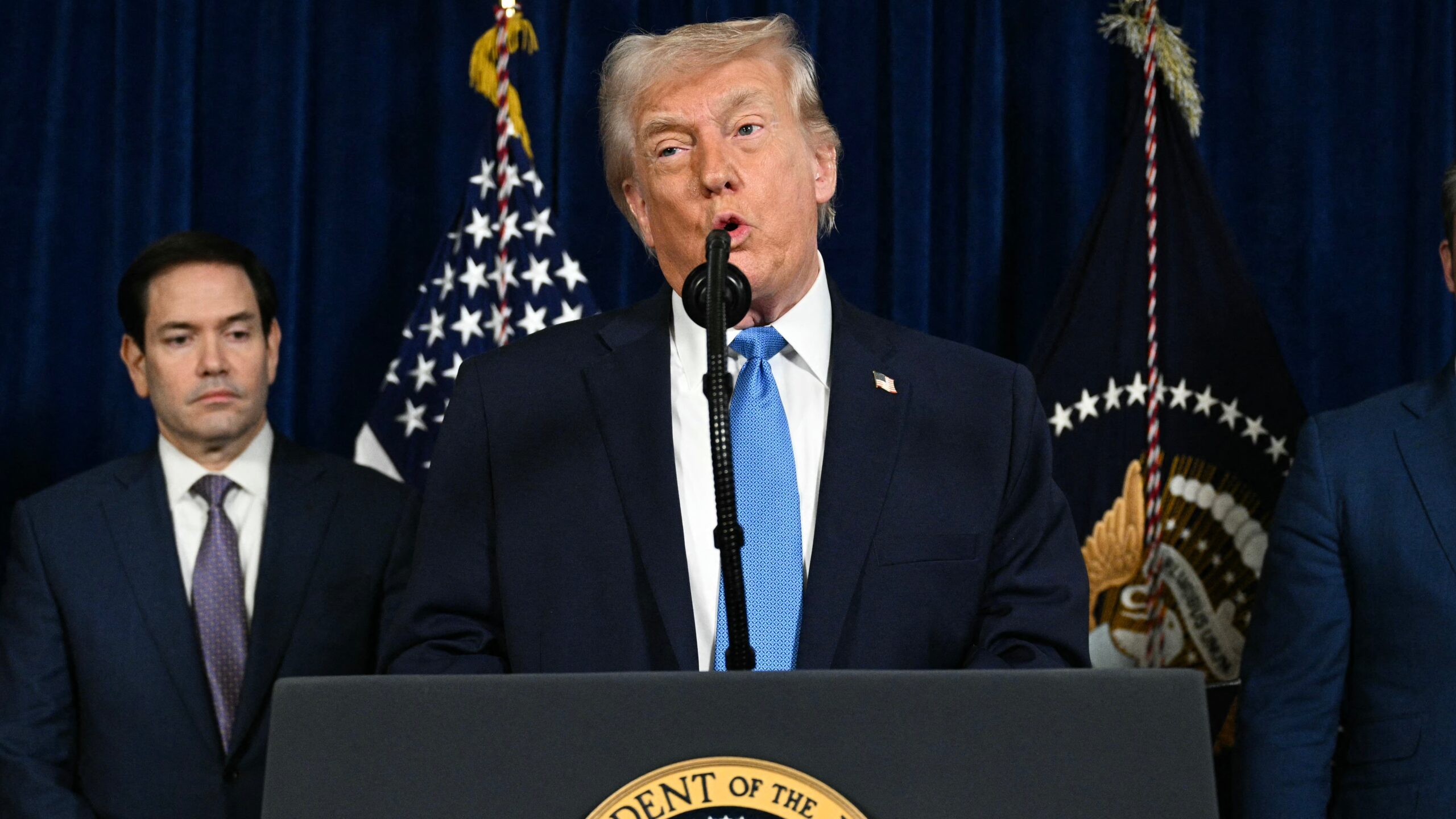
President Trump is boasting that he has concluded a great “deal” with Venezuela that would refill our depleted strategic petroleum reserves, reduce gas prices, and produce a long-lasting boon to America. As with all such Trump announcements, upon closer scrutiny, his boasts are empty and misleading. They also mask or neglect to note a much darker side to what has happened, the president’s judgment, his intentions, and the likely consequences of the whole endeavor.
Dig still deeper, however, and understanding the true nature of what has happened and where it may lead offers a direct path to better grasping the true risks of the Trump presidency, the origin of those risks, and how they tie directly into the core existential questions facing our society.
Trump said that what was worked out with Venezuelan authorities would give the U.S. access to 65 billion barrels of oil. Additional reporting indicated it would be done as part of a deal with a private Venezuelan oil company, North American Blue Energy Partners, owned by a Venezuelan businessman named Alejandro Betancourt Lopez. The U.S. would become a part-owner of that company and the new organization would receive, as a consequence, massive investment that could unleash oil production that would be enough to fill the U.S. strategic reserves, now at their lowest levels in decades as a consequence of tapping into them to make up for oil supply shortfalls related to the president’s illegal Iran War.
Trump, being Trump, hailed the deal as historic, world-changing, and observed it was being done in cooperation with the Venezuelan government headed by interim President Delcy Rodriguez, the U.S.-installed successor to former president Nicolas Maduro, who the U.S. seized in a raid on January 3 of this year. Since the time of that raid, Trump has promised that it would be paid for in part by giving the U.S. access to Venezuelan oil. Before announcing this deal, the U.S. obtained that oil through seizures of oil tankers and other acts of piracy.
Here are just some of the problems with Trump’s assertions about the arrangement, its nature and specifics:
The arrangement is very likely in violation of international law, Venezuelan law and possibly U.S. law. One cannot in circumstances like these seize national assets like oil fields through military conquest. Venezuela’s Constitution prohibits giving control of its oil fields to any foreign power. The U.S. president cannot allocate investment funds of the nature Trump has implied would be forthcoming, and the private ownership arrangement that reportedly directs the flow of funds to the U.S. Department of Defense is likely prohibited without Congressional approval.
The deal will not produce enough oil to restore our strategic reserves in the next several years, if ever. Venezuela’s oil infrastructure is damaged and insufficient and would require massive investment and work to ramp up sufficient production. Venezuelan oil is also “dirty,” hard to refine, and would require multiple additional costly steps to be produced in a form that could meet U.S. strategic petroleum reserve standards.
(And for the same reason, this deal has zero chance of affecting oil prices or availability during the remaining months of the midterm campaign, or in any way relieving the high cost of gasoline currently burdening Americans.)
It is not a “deal.” This is the U.S. illegally seizing the assets of another country via force; an act of bald-faced aggression, akin to Russia’s seizure of Eastern Ukraine (with similar economic motives). As a consequences, it tacitly gives license to other nations, like Russia, to use force to attack and steal from weaker neighbors around the world.
Read more Trump, 80, Nods Off During Oval Office Sycophancy Session
The counterparts in this deal are deeply unsavory. First, the U.S. has not historically recognized the Maduro regime that remains at least tacitly in charge in Venezuela. Therefore, Rodriguez and her government are in no position to approve the deal. Secondly, in reaching the arrangement with Rodriguez, the U.S. actually strengthens the corrupt, anti-Democratic regime that we have long condemned during both the Chavez and the Maduro eras. The company involved is run by a man under investigation for money laundering by multiple countries worldwide. The U.S. has already reportedly used diplomatic pressure to help reduce international pressure on him. Betancourt Lopez and his company rose to prominence by cutting deals with the Chávez regime. The regime has been regularly condemned by the U.S. as being corrupt, and deals such as this are precisely the type that have generated the most scrutiny and concern. Further, for these reasons, it is unlikely any future U.S. administration would support this relationship, thus cutting it short before the U.S. could derive any real benefit (while noting that any such benefit would be an act of international theft).
The people of Venezuela are growing increasingly unhappy that, after the U.S. removed Maduro, we did not produce any notable positive changes for average Venezuelans, that Rodriguez and Co. remain in power, and now that their national patrimony is being looted by Trump.
In other words, the U.S. illegally attacks a country, kidnaps its president, threatens its government with massive military force, gets them to hand over to US control a huge portion of their national assets, hails the billions it has already brought in and promises billions more but we don’t know where the money’s going, how it is going to benefit the U.S., if it is going to benefit the US, who’s privately going to benefit, what side deals have been struck with the corrupt leaders of their country or ours, does so in a way that is terrible for U.S. national interests and we are supposed to celebrate an act that could very well turn out to be a massive mafia-style shakedown scheme to benefit the anti-democratic forces in Venezuela and the U.S., the president’s friends and supporters, possibly the president and his family?
This last point is especially salient since, to date, there has been much reasonable concern about where the proceeds from U.S. seizure of Venezuelan oil have gone. They reportedly, per the administration, were directed to a bank account in Qatar. The beneficiaries of the funds in that account or their whereabouts are not publicly known. Given Trump’s record of enriching himself via shady means throughout his current term of office, it is reasonable to ask about those activities and this arrangement: qui bono?
What has happened in Venezuela and what’s about to happen demands investigation, forensic audits, international scrutiny. We need to know terms, details. We need to see the financial terms and monitor what happens. And if it is as corrupt as it seems, Trump belongs in jail next to Maduro (or in his place).
The uncritical coverage of all this by the press, including many in the mainstream media that celebrated Trump’s illegal attack on Venezuela as a “success,” deserves scrutiny & criticism of its own. As does the complicity of many in Trump’s cabinet and the compliance of Congress.
A Democrat-controlled Congress needs to make investigating this a priority. State AGs with jurisdiction over participating companies, and perhaps the underlying financial arrangements, should get involved. International prosecutors with jurisdiction should do the same. We’re sleepwalking through a massive scandal.
The question is: Will we do what we must?
My guess is that will only happen if we realize the scope, depth and implications of the problem with which we are confronted.
Read more ICE Goes Full RoboCop With $2 Million Mechanical Mutts









Post Comment