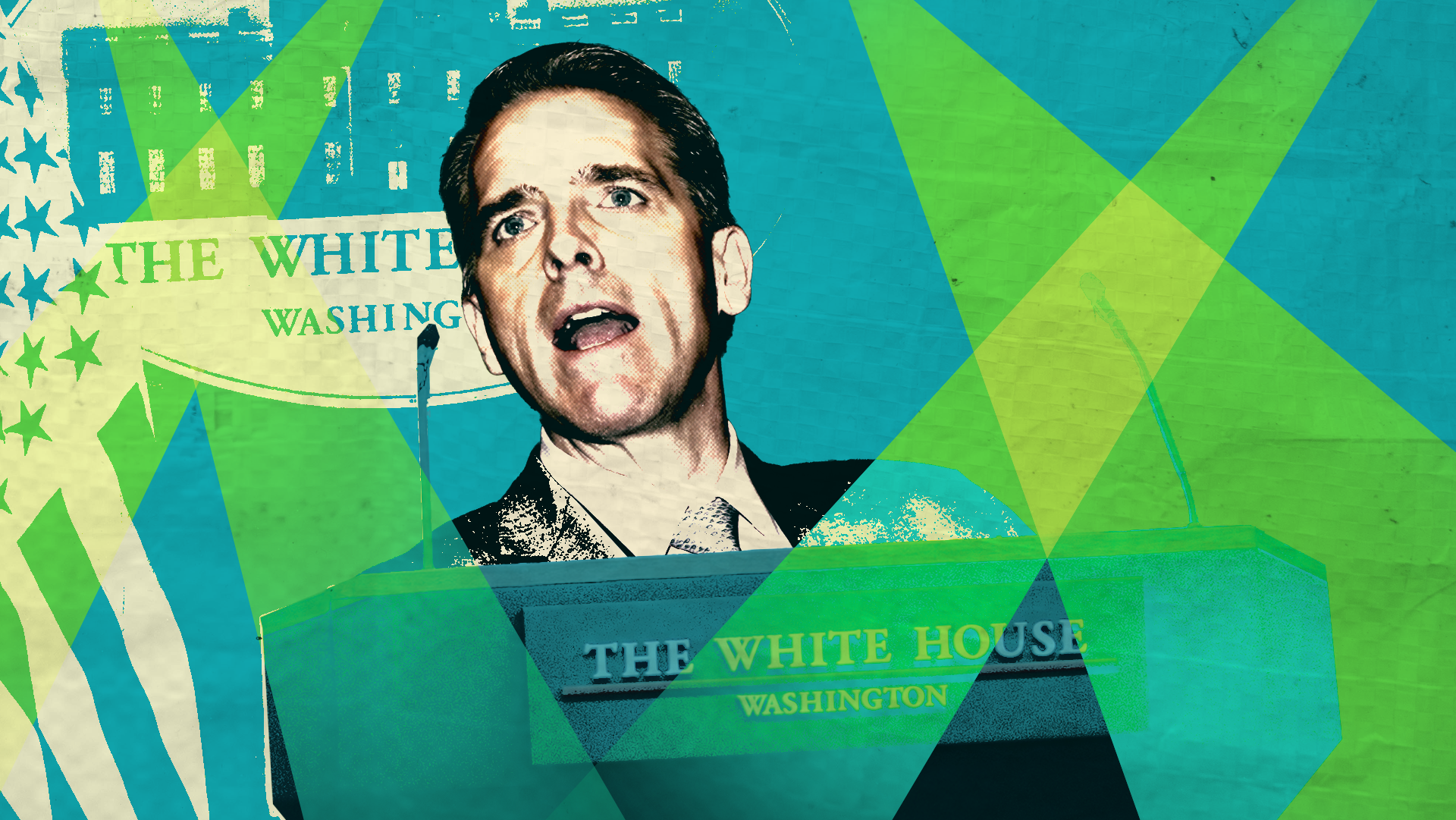
I Was Scott Jennings’s Student. He Should Be Nowhere Near the White House Press Podium
I enrolled in Harvard University’s course on Modern American Political Campaigns in the fall of 2020. Though I was generally interested in the subject, as part of my dual degree program at Harvard’s law school and school of government, I had also signed up because of one of the instructors, Robby Mook. Mook was Hillary Clinton’s 2016 campaign manager, and I had met him a few times in passing while working on the campaign’s digital team at its Brooklyn headquarters.
Read more MAGA Melts Down at CNN Over Brother of Trump’s Blonde Aide
Scott Jennings, his Republican co-professor, was a name I didn’t recognize. Jennings had joined Harvard’s Institute of Politics as a resident fellow in 2018, a year after the school’s controversial offer of that same fellowship to Trump’s first Press Secretary Sean Spicer. He later became an adjunct professor.
So I did what any curious student does: I looked him up.
Most people today know Jennings as a smirking Trump defender on CNN. Jennings provides an endless supply of ragebait for CNN’s roundtable shows and is paid handsomely to do it. Far fewer remember the multiple White House controversies he’d been embroiled in earlier in his career, which betray the deeper ethical rot we now see as he contorts himself on cable for MAGA approval.
My Google search revealed that he was entrenched in one of the Bush White House’s biggest ethics scandals, over whether federal prosecutors were being pushed out for failing to serve Republican political interests. Take then-New Mexico U.S. Attorney David Iglesias, who had angered Republicans by not moving aggressively enough on voter-fraud cases and a corruption investigation involving Democrats. Jennings, a special assistant to the president, wrote that the White House should “move forward with getting rid” of him—and Iglesias was later fired.
The Justice Department Inspector General later concluded that those politically charged complaints—not the performance problems that were later cited—were the real reason Iglesias lost his job.
The ensuing scrutiny on Jennings later revealed his use of a Republican National Committee email account for White House business. (But her emails! I know, I know.) And when the Senate Judiciary Committee later subpoenaed him, he invoked the Bush White House’s executive-privilege claim and refused to answer many substantive questions about his role.
“Have you read Scott’s Wikipedia?” a friend and I gossiped. But Harvard had put Jennings in the classroom. And that carried an implicit assurance to students that he was a legitimate practitioner of American politics, someone whose career was worthy of study rather than disqualification.
What struck me most during the course was how much the setting appeared to mean to him. Jennings returned again and again to the distance he had traveled in life to be there—from Dawson Springs, Kentucky, population barely two thousand, to an Ivy League lectern. He told his story with real feeling (though, sure, the whole ethics scandals part was omitted). Harvard wasn’t just any gig for Jennings—it seemed like some kind of proof.
He was, to be fair, a capable presence in the class; comfortable, quick-witted, and willing to share his insights with a room that likely skewed heavily Democratic. He brought in high-profile GOP friends like controversial pollster Frank Luntz. He even criticized Trump when he thought Trump deserved it, including after the January 6 insurrection. In other words, whatever came later was a choice, not a conviction.
Read more Melania to Put On a United Front With Trump Amid Blonde Companion Drama
The moment I’ve thought about most came during office hours. I asked Jennings and Mook, in separate meetings, for advice on how someone breaks into television commentary. I had made a few appearances on a local Boston station and had enjoyed it. Jennings answered without hesitation or embarrassment: he told me he had paid a third-party booking agent something like $25 per hit to help get him on CNN. His goal was to get a real contract with the network, which he later did. When I later asked Mook about that strategy, he seemed genuinely thrown. He told me he had never heard of anyone doing that.
(CNN and Jennings did not immediately provide a response to requests for comment.)
I’ve never forgotten that, and it lands differently now. Jennings didn’t storm some clichéd gates. He found the price of admission and paid it. The populist who rails against elite institutions is a man who studied exactly what those institutions confer and set about acquiring it, deliberately. So as he smears his former students as schooled “only” in the downfall of Western civilization, he sounds like a massive hypocrite.
Trump’s press secretaries have lied from that podium before, as have all those who sacrifice credibility for the chance to be in Trump’s orbit. Spicer started right out of the gate with his nonsense about Trump’s inaugural crowd size. Kayleigh McEnany promised she never would, then did, fluently. Sarah Huckabee Sanders, now governor of Arkansas, gaslit the public better than all of them. Karoline Leavitt has spent this term defending the indefensible without even the slightest hesitation.
But none of them arrived with what Jennings has. They were understood, correctly, as personal, partisan mouthpieces for Trump. Jennings, though, would walk into the briefing room carrying credentials from the country’s most prestigious university and a rubber stamp from a major news organization.
Imagine him pushing back on a CNN reporter from that podium who, months earlier, was his colleague. That familiarity carries its own kind of authority and benefit of the doubt. (Recently, when Jennings claimed on air that he’d spoken by phone with an ailing, absent Mitch McConnell, the network publicly clarified that he is a commentator rather than one of its journalists and that his account was “not CNN reporting.” Let’s face it though—viewers see a man at a CNN desk.) That’s the real danger. Not that Jennings will lie more than his predecessors, but that he will be believed more while doing it.
Maybe he doesn’t get the job. This White House loves to gameshow-ify its personnel decisions, Apprentice-style. And Trump loves to play his lackeys—even the most loyal among them—against each other. But that he’s plausibly the frontrunner is still deeply revealing of the moment the country is in.
Having watched his ascent up close, I’m left with the impression that there are very few principles Jennings would allow to stand between himself and the next rung of power. The podium at stake now is a great deal higher than a lectern at Harvard.
Read more Even Republicans Are Calling BS on Trump’s Giant Cash Grab








Post Comment